When did you last change the water filter? If you have to open a Notes list to find out, and the Notes list says "Sept?", you don't have a home maintenance tracker. You have a diary of guesses.
The simplest home maintenance tracker does one thing: it records the day you last did each job and shows how many days it's been since. Not a schedule, not a list of overdue tasks. Just the fact, so you can decide.
When did I last change the water filter?
Here's a real kind of list, the one lots of us keep in a notes app:
- Water filter: changed early Sept?
- Air filter: summer sometime
- Dentist: spring, I think
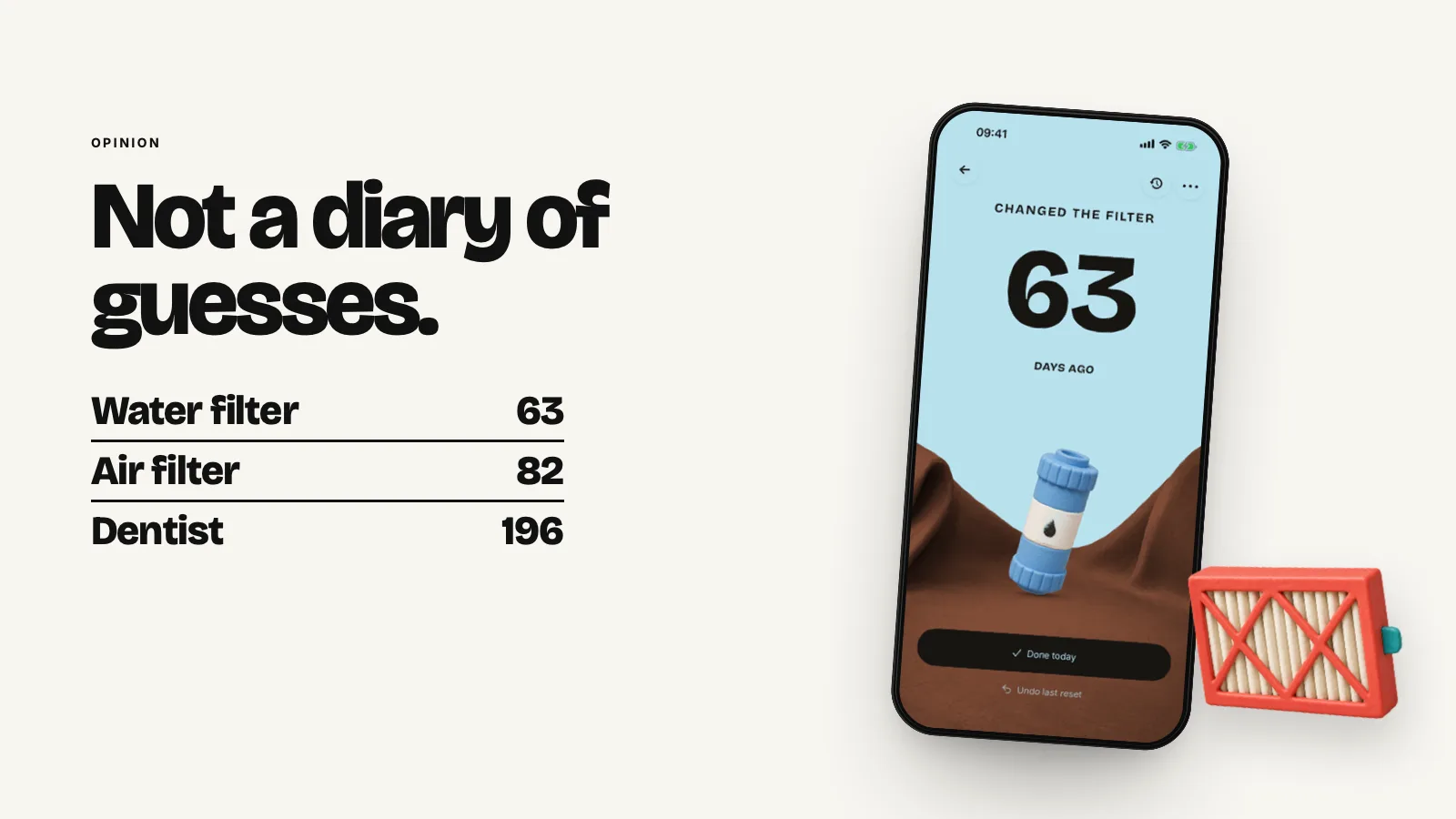
Now here's the same list as of today, 27 October, counted from the actual dates:
- Water filter: 63 days (changed 25 August, not "early Sept")
- Air filter: 82 days (6 August)
- Dentist check-up: 196 days (14 April)
None of the guesses was a number, and the one that tried to be specific was wrong in the flattering direction. That's normal: older, routine moments tend to feel closer than they are. We wrote about why in How long ago was it, really?.
Why doesn't a Notes list work?
Three reasons. It stores a guess, because you wrote it after the fact. It stores a date, when the question you actually have is "how long ago?", so you're doing arithmetic every time you look. And it only updates when you remember to update it, which is exactly the thing you're bad at, or you wouldn't need a list.
Why not a maintenance schedule instead?
The schedule version goes like this. Every job gets an interval, every interval becomes a due date, and every due date becomes a red badge. Within a month you have eleven overdue items, the app looks like a charge sheet, and you mute it.
Schedules also pretend to know things they don't. Filter guidance varies by product: follow the instructions on your filter's box, not a generic default. For heating and cooling systems, ENERGY STAR suggests inspecting, cleaning or changing the air filter once a month (ENERGY STAR). A number like 82 days tells you what you need to know about that without a single notification.
The number is information. What you do with it is up to you.
What should a home maintenance tracker include?
Whatever you'd otherwise guess about. A decent starting list:
- Water filter
- Air filter (furnace or HVAC)
- Tested smoke alarm (see why monthly matters)
- Descaled kettle
- Car service
- Cleaned dishwasher filter
- Dentist check-up
That's seven, which is also where the free version of Last. stops. Gutters, fridge coils and bleeding the radiators can wait for a second list, or for Last Plus.
How Last. does it
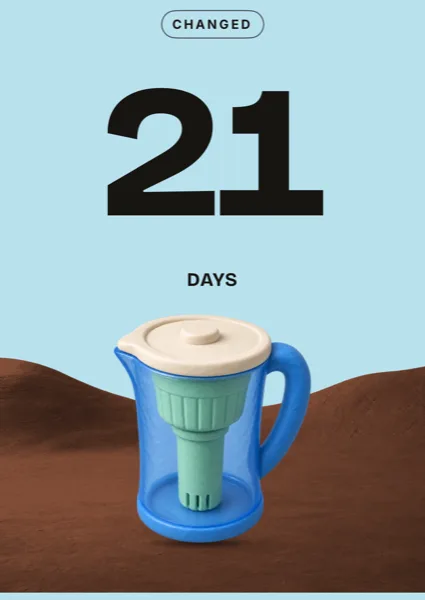
Each job is a Since thing with one big number: the days since you last did it. When you do it again, tap once. The counter goes back to zero and the old number becomes a print, a small poster of that gap, so over time you can see how long you really leave things.
- One tap to log: from the app, and from a Home Screen widget.
- No schedule: nothing is ever "overdue", because nothing was ever due.
- Optional reminders: a nudge when it's been a while, only if you ask for one. Never a daily check-in.
- No account: nothing to sign up for, and no ads.
Last. is free for up to 7 things. Last Plus or Last Lifetime adds unlimited things, every widget layout and full history with Gap Rhythm, which shows the gap between every water filter change you've ever logged.
FAQ
What's the easiest way to keep track of home maintenance?
Record the date you do each job and look at the days since. A counter per job beats a schedule you'll end up ignoring.
How often should I change my water filter?
It depends on the filter. Follow the manufacturer's instructions on the box, and track the days since your last change so you can compare.
How often should I change my furnace or AC air filter?
ENERGY STAR suggests inspecting, cleaning or changing it once a month for central air conditioners, furnaces and heat pumps.
Is there an app that tracks when I last did something?
Yes. Last. shows the days since each thing you track and resets with one tap. It's free for up to 7 things, with no ads and no account.