Quick: when did you last get the car serviced? If your answer starts with "about", it's probably wrong, and probably too recent.
The short answer to "how long ago was it?" is: count the days from the date it happened to today. The trouble is that almost nobody has the date. We have a feeling instead, and for anything more than a few weeks old, that feeling is a bad witness.
How long ago was it, really?
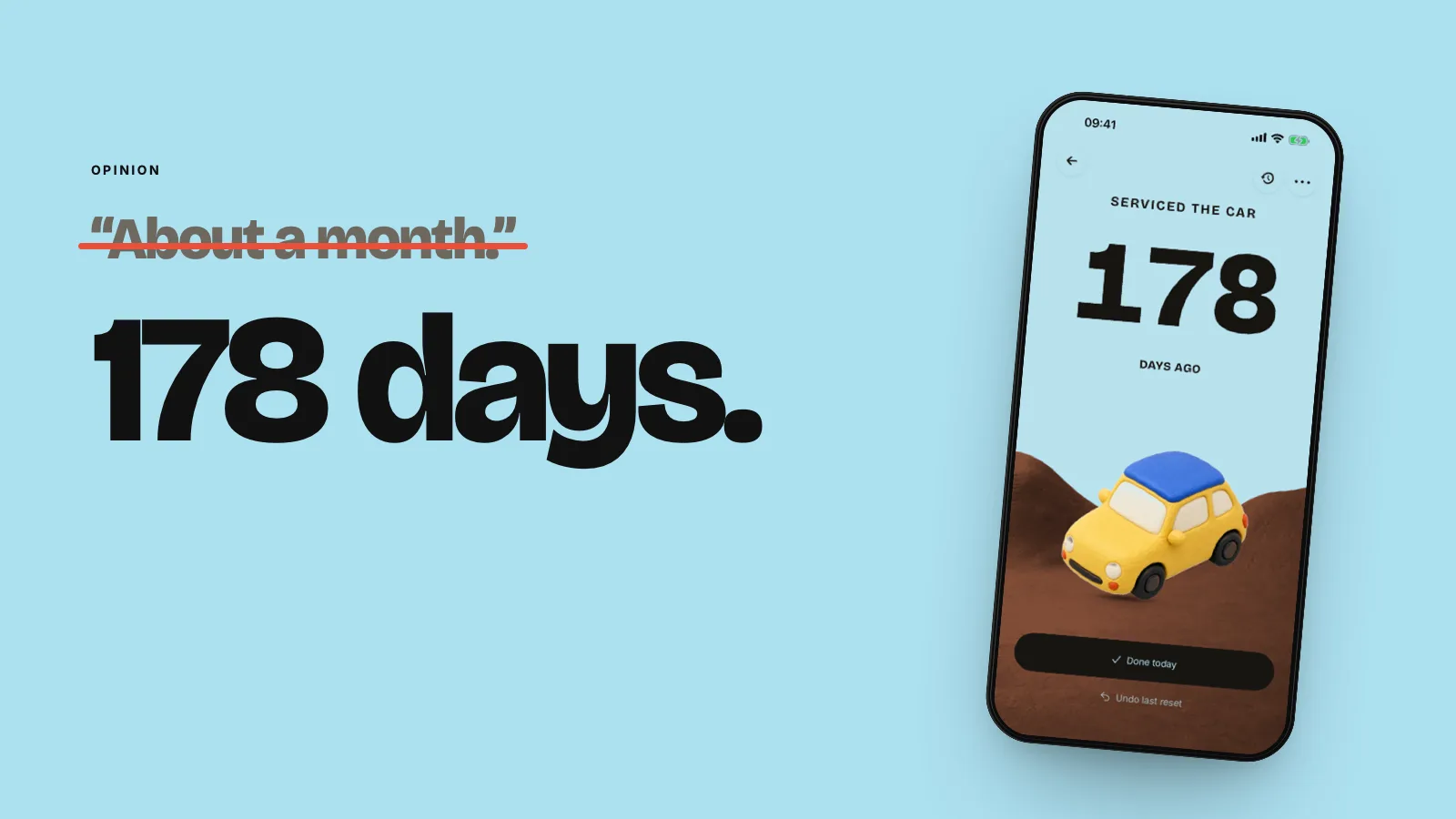
Here's a car serviced on 12 April 2026. Ask its owner today, 7 October, and you'll hear "a month or two ago, maybe". The real number is 178 days. Nearly six months.
That gap between the feeling and the number is the whole reason Last. exists. It's not a memory test anyone fails on purpose. Routine jobs just don't leave landmarks. One oil change looks exactly like the last one, so your brain has nothing to pin it to, and it quietly files it under "recently".
Why does it feel so much more recent?
Psychologists have a name for part of this: telescoping. When people date past events, they tend to move them in time. In a 2006 study in Memory & Cognition, Janssen, Chessa and Murre asked people to date news events and found a large forward telescoping effect for remote events: older events were placed closer to the present than they really were (Janssen, Chessa and Murre, 2006).
The same study found something more useful. Answers given as an absolute date ("July 2004") were more accurate than answers given as relative time ("3 weeks ago"). In other words, "how long ago" is the worst way to ask the question. "On what date" is better. And the best answer isn't remembered at all. It's written down.
How do I work out how many days since a date?
If you do have the date, a days-since calculation is simple arithmetic. Take 12 April to 7 October:
- The rest of April: 30 − 12 = 18 days
- May, June, July, August, September: 31 + 30 + 31 + 31 + 30 = 153 days
- October so far: 7 days
18 + 153 + 7 = 178 days. In a spreadsheet (Excel, Google Sheets or Numbers), put the date in a cell and subtract it from TODAY(): =TODAY()-A1 gives the same answer.
So the maths was never the problem. The missing date is the problem. You can't calculate days since something you never recorded, and a guess run through a calculator is still a guess.
Why "about a month" is a costly answer
Underestimating time feels harmless until you add it up. The water filter that "was changed recently" has been in for 63 days. The air filter you swapped "sometime in the summer" is on 82. The smoke alarm you "just tested" is at 211. None of these is a disaster on its own. Together, they're a house running on vibes.
Janssen and colleagues also found a small effect in the other direction: recent events were pushed slightly further back. The study used news events, but if your chores behave anything like the news, the error isn't random. Last week drifts back, last spring drifts forward, and everything ends up in a vague middle called "a while ago". That's exactly where maintenance goes to be forgotten.
Count it instead
The fix is boring, which is why it works: record the day you do the thing, and let something else do the counting. A note with a date is better than nothing. A counter is better than a note, because it does the subtraction every day without being asked.
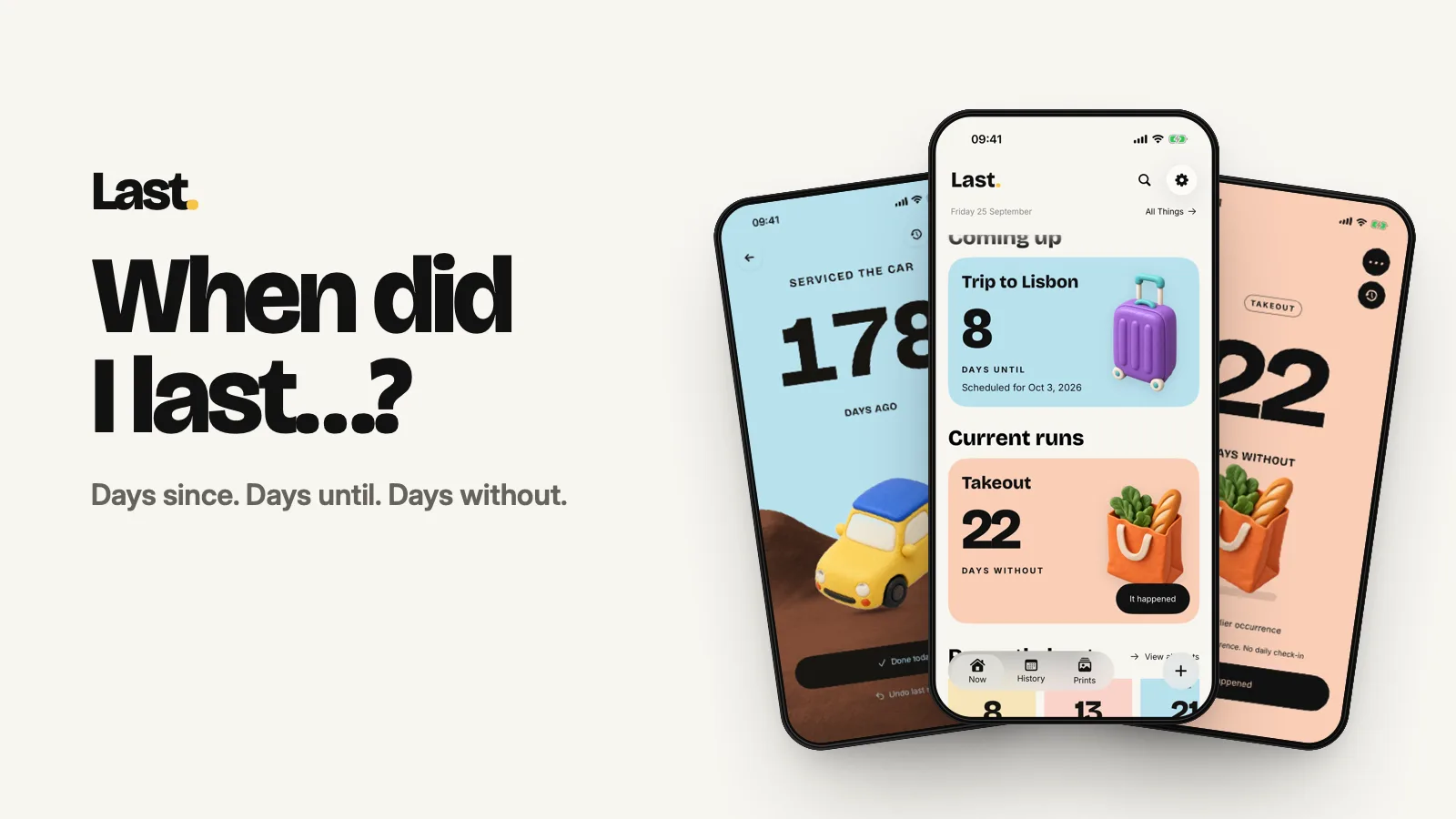
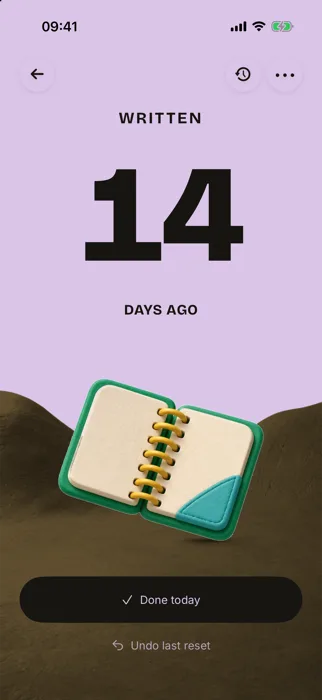
That's what I built Last. to do. Every thing you track has one number: the days since you last did it. When you do it again, you tap once and the number goes back to zero, and the old count becomes a print you keep. No schedule, no streak, nothing to fall behind on. Just the number, where you'll see it, including on your Home Screen.
The next time someone asks when you last did something, you won't say "about". You'll say a number.
FAQ
How do I calculate how many days ago a date was?
Subtract the date from today. By hand, count the days left in the starting month, add every full month in between, then add today's day of the month. In a spreadsheet, =TODAY()-A1 does it for any date in A1.
How many days is six months?
Between 181 and 184 days, depending on which months. 12 April to 12 October 2026 is 183 days.
Why do I think things happened more recently than they did?
Researchers call it forward telescoping: older events tend to be dated closer to the present than they really were. Routine events are especially hard to date because they look alike.
Is there an app that tells me when I last did something?
Yes. Last. counts the days since each thing you track, and resets with one tap when you do it again. It's free for up to 7 things.